Malcolm Staples Takes the Lead: A Front-Row Look at His First Self-Produced NYFW Show
Updated: Sep 24
Tailoring, ownership and a collection that proved structure doesn't have to play it safe.
Written by Patricia “Alwayz A Lady”Fashion Stylist | Image Consultant | Fashion & Lifestyle Correspondent
New York Fashion Week | September 13, 2026
Photography by Kevin Higgins of The Runway Authority

There are fashion shows you attend for the clothes, and then there are fashion shows where you realize you're watching a designer step into a new chapter of his career.
For me, Malcolm Staples' September 13 presentation during New York Fashion Week was both.
Sitting front row at Flat Iron Studios in Chelsea, I watched Malcolm present his latest collection during an afternoon of fashion that also created runway space for fellow designers.
But this show represented something much bigger for Malcolm.
During our conversation, he shared with me that this was the first fashion show he had produced himself.
Now, let me tell you why that matters.
From Showing on the Runway to Producing the Runway
If you only experience New York Fashion Week through social media, it can look like one big glamorous party.
The lights. The photographers. The front row. The models. The fabulous clothes.
But baby, somebody had to pay for all of that.
Fashion Week is business.
Producing your own runway show means thinking far beyond designing a collection. There's the venue, models, casting, fittings, production, lighting, sound, hair and makeup, backstage coordination, photography, videography, PR, invitations, seating and a hundred little details the audience should never notice when everything goes right.
And somewhere in the middle of handling all of that?
You're still supposed to be the designer.
That's what made this moment important.
Malcolm had already experienced New York Fashion Week through established platforms, including EMERGE!, and had spent years developing his reputation as a custom clothier and designer.
But being invited onto someone else's platform and putting your own name at the top of the production are two very different things.
This time Malcolm wasn't simply occupying the space.
He was creating it.
And he didn't make the runway exclusively about himself. His production also gave additional designers an opportunity to present their work before the audience he had assembled.
There's something powerful about finally getting your own table and still making room for somebody else to pull up a chair.
Malcolm also shared that his first self-produced show sold out.
For an independent designer taking that kind of financial and creative risk during New York Fashion Week, that's not a small accomplishment.
People showed up for what Malcolm Staples built.

Before the Runway, There Was the Tailor
If this show was your introduction to Malcolm Staples, understand that his career didn't begin with Fashion Week.
Originally from Saginaw, Michigan, Malcolm established his fashion business in the Washington, D.C. metropolitan area and built a reputation around custom clothing and tailoring for men and women.
His relationship with style goes back even further.
Malcolm has spoken publicly about the influence of his grandfather, whom he remembers as an exceptionally well-dressed man. That appreciation for presentation and classic menswear helped shape Malcolm's own relationship with clothing.
I love that part of his story because fashion is sometimes inherited in ways that have absolutely nothing to do with money.
Sometimes it's watching how somebody gets dressed.
How they press their clothes.
How they put on their jacket.
How they walk differently once they're dressed.
Those little things stay with you.
Eventually they become part of your own visual language.
Malcolm went on to dress professional athletes and other notable clientele while expanding his work through runway presentations in New York and other markets.
So although this was his first self-produced fashion show, this was certainly not Malcolm Staples' first introduction to fashion.
This was experience meeting ownership.
From My Stylist's Eye: Tailoring Was the Foundation, Not the Limitation
Now let's get into these clothes, because this is where the stylist in me kicked all the way in.
After watching Malcolm's collection, one thing became very clear:
Tailoring may be his foundation, but it is not his limitation.
The collection moved between masculine and feminine, structure and sensuality, wearability and full-on runway drama.
Black dominated much of the story, but Malcolm kept it from becoming repetitive through changes in texture, construction and proportion.
There was lace.
There was shine.
There was pleating.
There were feathers.
There was corsetry.
There were exaggerated shoulders.
And honey, there were hats.
Menswear Codes With a Feminine Attitude
One of my strongest looks was a black mini that played beautifully with traditional menswear references.
The fitted buttoned bodice gave the feeling of a tailored vest, while the crisp white collar and elongated tie detail reinforced that menswear influence.
Then Malcolm flipped the conversation with a short, tiered ruffled hem.
And then came that oversized black hat.
Baby, the hat entered the room before everybody else did.
That's styling.
The hat wasn't simply placed on the model because somebody thought the outfit needed an accessory.
It changed the entire silhouette.
That's something I constantly teach about personal style: an accessory should have a job.
Sometimes its job is to complement.
Sometimes it's supposed to finish.
And sometimes its job is to walk into the room five seconds before you do.
Proportion Is Everything
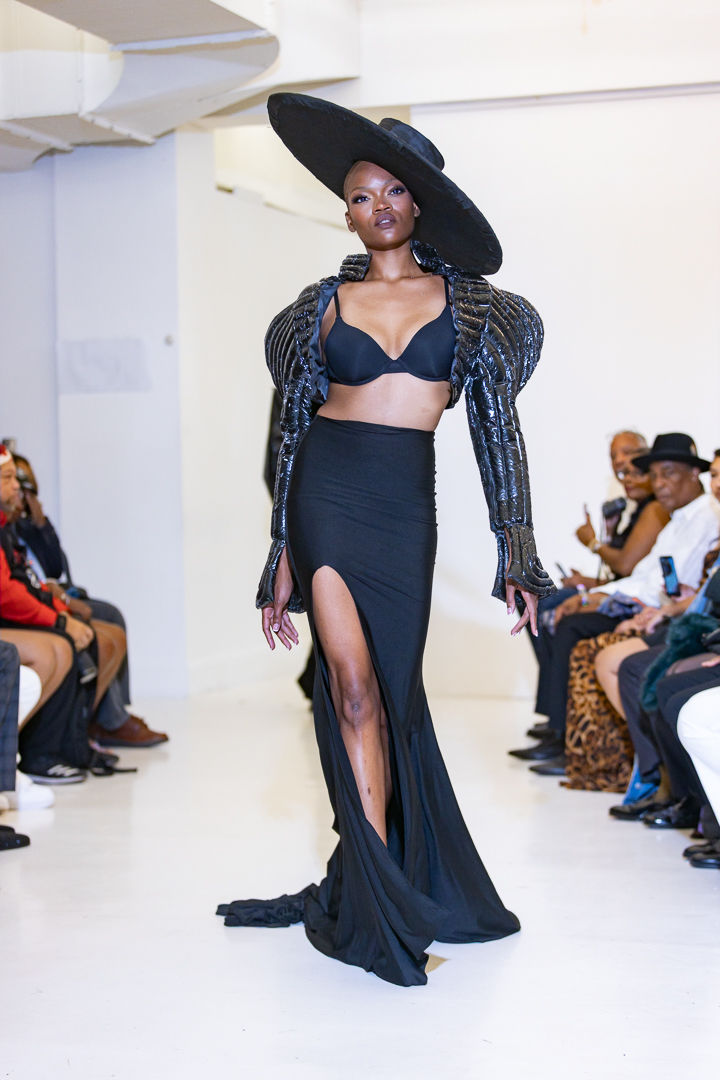
Another standout black look showed the more sensual side of the collection.
A long, body-skimming skirt with a dramatic thigh-high slit created a beautiful uninterrupted line down the body.
Above it, Malcolm went in the opposite direction.
An exposed bra was paired with a cropped, highly structured jacket with exaggerated shoulders.
This is where proportion becomes important.
When you're creating that much volume around the shoulder, everything else doesn't have to compete.
The simplicity and length of the skirt allowed the architecture happening above the waist to become the focus.
Sexy without giving me too much.
Dramatic without becoming costume.
That's balance.

And Then Came the Blue
Just when your eye had settled into Malcolm's black-and-white story...
Here comes that blue.
The electric-blue jumpsuit was one of those pieces designed to move.
Strong shoulders, dramatically ruched sleeves and sweeping panels behind the model created an entirely different energy on the runway.
It wasn't quiet.
And it wasn't supposed to be.
That's a runway moment.
But what interested me was that underneath all that drama, you could still see Malcolm's understanding of construction.
The drama wasn't hiding the garment.
The construction was creating the drama.
There's a difference.
Pleating Became Part of the Architecture
Another black look demonstrated that same idea in a completely different way.
Pleating framed the upper body and traveled dramatically along the outside of the trousers, creating volume while maintaining a controlled center silhouette.
Later, a sophisticated black tailored look used pleating again—this time through the jacket and wide-leg trousers.
Same design element.
Completely different woman.
And that is something I appreciate as a stylist.
A designer doesn't always need another embellishment.
Sometimes manipulating the fabric itself is the embellishment.

The Tailor Was Still in the Room
Then came the menswear.
A crisp white elongated coat over black trousers immediately brought me back to Malcolm's tailoring foundation.
The silhouette was clean.
The shoulder was controlled.
The length gave the coat presence without needing unnecessary embellishment.
Then there was that zebra-print detail at the neck.
Because throughout this collection...
that zebra kept talking.

Zebra, But Make It Malcolm
We saw zebra appear in multiple ways throughout the collection, but the zebra cape-style blazer mini was one of the most commercially interesting pieces for me.
It's bold.
It's tailored.
It's sexy.
It's dramatic.
But I can immediately see it outside the runway.
That's the difference between something being theatrical and something simply having personality.
And baby, if you're wearing zebra with a cape, you did not get dressed to disappear.
That's my kind of woman.

Malcolm Gave Us More Than One Woman
The deeper the collection went, the more I realized Malcolm wasn't giving us one definition of femininity.
There was a black corseted look combining shine, lace and transparency while still maintaining structure.
Then came a dramatic black feathered gown with sharply defined shoulders, an embellished serpentine detail through the center and movement through the high-low silhouette.
One woman was tailored.
Another was sensual.
Another was dramatic.
Another was powerful.
And sometimes?
She was all four.
From a stylist's perspective, that's what gives me something to work with.
But Can We Actually Wear It?
This is where my stylist brain will always take over.
Because while I love runway fantasy, I also want to know what happens after Fashion Week.
Can I style it?
Can my client wear it?
Can we separate it?
Can we change its attitude?
Can we get our cost per wear?
Take the oversized hat away from that black mini and pair the look with a great pump or boot.
Different woman.
Separate a zebra skirt from its coordinating top and style it with a crisp white button-down, fitted black knit or blazer.
Different wardrobe.
Take one of Malcolm's dramatic black separates and pair it with something quiet.
Different occasion.
That's what I look for.
I don't only want a garment that produces a great runway photograph.
I want clothes with possibilities.
Malcolm gave us runway fantasy.
But underneath the exaggerated shoulders, hats, zebra, feathers and drama, I could still see the tailor.
The show gave us fantasy. The clothes still gave us options.
When You've Seen the Idea Somewhere Else
There was another conversation I wanted to have with Malcolm after researching his work.
I had seen certain ideas within his previous designs that felt familiar—not because I could establish that someone had copied Malcolm's exact garment, but because similar concepts have appeared throughout wholesale and mass-market fashion.
That raises a much larger industry question:
What happens when an independent designer develops a distinctive idea and similar concepts eventually appear at mass-market scale?
Fashion has always referenced fashion.
Trends cycle.
Archives inspire.
Silhouettes disappear and return.
But today's fashion cycle moves incredibly fast.
An independent designer can spend months developing a concept while a major manufacturer has the infrastructure and distribution network to bring trend-responsive merchandise to thousands of consumers.
And the consumer who eventually sees the $39 version hanging on a rack may never know where similar creative ideas first appeared.
That conversation matters for all independent designers.
It carries another layer when we're talking about Black designers who historically haven't always had equal access to capital, manufacturing, retail placement and the institutional support required to scale their businesses at the same speed as major fashion companies.
Originality is creative.
But being able to own, manufacture and profit from your creativity is business.
And fashion needs both.
Being a Black Designer in This Space Matters
I don't want Malcolm being a Black designer to become the entire story.
He's a designer.
The clothes deserve to be discussed.
The craftsmanship deserves to be discussed.
The construction deserves to be discussed.
And the business deserves to be discussed.
But I'm also not going to pretend that an independent Black designer producing his own show during New York Fashion Week carries no significance.
It does.
Black designers have contributed enormously to American fashion and global culture while historically facing barriers to financing, manufacturing, retail relationships, press and institutional recognition.
That's why ownership matters.
Malcolm had already been invited onto established platforms.
This time?
He built his own.
And then he made room for other creatives to walk through the door with him.

From the South Side to the Front Row
Being a South Side Chicago girl will probably always influence the way I experience fashion.
Chicago taught me early that great style isn't always about a label or price tag.
Sometimes it's attitude.
Sometimes it's presentation.
Sometimes it's taking something, putting your own sauce on it and walking out the door like nobody else could have worn it quite the same way.
We know how to put something ON.
So sitting front row, I wasn't simply asking whether Malcolm's clothes photographed beautifully.
I wanted to know:
Can I style it?
Can my client wear it?
Does it have longevity?
Does the construction support the idea?
Does it have enough personality to introduce the person wearing it before she ever says a word?
Because that's what great fashion can do.
It gives you confidence.
Presence.
Identity.
And maybe just a little swagger.
More Than Another NYFW Show
By the end of the afternoon, my biggest takeaway wasn't one dress, one jacket, one hat or even one runway moment.
It was progression.
Malcolm Staples has built his foundation through tailoring.
He's developed a clientele.
He's shown his work on established platforms.
He's presented during New York Fashion Week.
His work has traveled beyond New York.
And now he can add another title to that journey:
Producer.
His first self-produced fashion show during New York Fashion Week placed his name at the center while still creating space for other designers.
And according to Malcolm, the show sold out.
That's not the end of the story.
It feels more like the beginning of another chapter.
Because eventually there comes a point when being invited into the room isn't enough.
You learn the room.
You build the relationships.
You understand the business.
You perfect your craft.
You establish your audience.
And eventually?
You create your own room—and invite everybody else to come see what you've built.
Malcolm Staples did exactly that.
And this South Side girl had a front-row seat to watch it happen.

Written by Patricia “Alwayz A Lady”Fashion Stylist • Image Consultant • Fashion & Lifestyle Correspondent
Photography: Kevin Higgins
All runway photographs featured in this article are credited to photographer Kevin Higgins.
You are the CEO of your life—and your style should introduce you accordingly.
Continue the story → When Your Moment Becomes Our Moment: Malcolm Staples Created the Runway—Then Made Room for More.
Comments